1.12.15

Welson Super-Matic S12

dear fellow tinkerers and lovers of the vintage and obscure.
i got one of these in recently:


aah. cheese.
it came with the question if it was possible to have separate triggers and outputs for all the sounds, possibly individual volume controls etc. foolishly, i gave my standard answer ("sure!") before realising there was no such thing as a free interweb-floating schematic of this thing. nooo infooo whatsoooever.

so yes, i set about doing just that.. tracing the fucker.
partial schemo below. didn't do the bottom board, which is the rhythm and pattern generator. you're on your own there.

so 6 hours later, it turns out there's 4 twin T based oscillators (kick, tom1, tom2, claves) and 2 filtered noise sounds (hh and snare.)
the hh has a long and short option. the snare always triggers tom1 with it to add some bottom end, and includes an LFO in it's trigger circuitry that allows for drum rolls. note that that means the rolls have a fixed tempo, as in: not a division of the master tempo. just let it go fast enough, no one'll ever know. nifty. i would think that also means that snare triggers have to be short enough so as to allow for less than a full LFO cycle, to avoid double hits.
when tom1 is used on its own (in exactly 2 presets), it's made slightly longer - in a vain attempt to set it apart from the snare sound, i would guess. oh, and there's an accent trigger on the output amp.

good modding news: there's prefab trimmers for oscillator gains (usable as length controls), volumes and roll speed.
twin T oscillators are not the friendliest to throw in a pitch control, but i hope to manage that by using dual ganged pots replacing the series resistors in the first of the T's. hope to manage additional manual triggers for kick, snare and hh (complementing the funky Big Buttons already there.)


the real fun starts when you start crossbending what is essentially crude data lines - using the trigger line for the samba clave rhythm on the kick, for example. here's a quick and dirty example of that. i think it sounds gorgeous.

the casing and the way the whole innards slide in do not exactly leave an abundance of space to put extra switches, knobs and pots in, so we'll have to work our way around that..


1.3.15

Jazzmaster - now what?


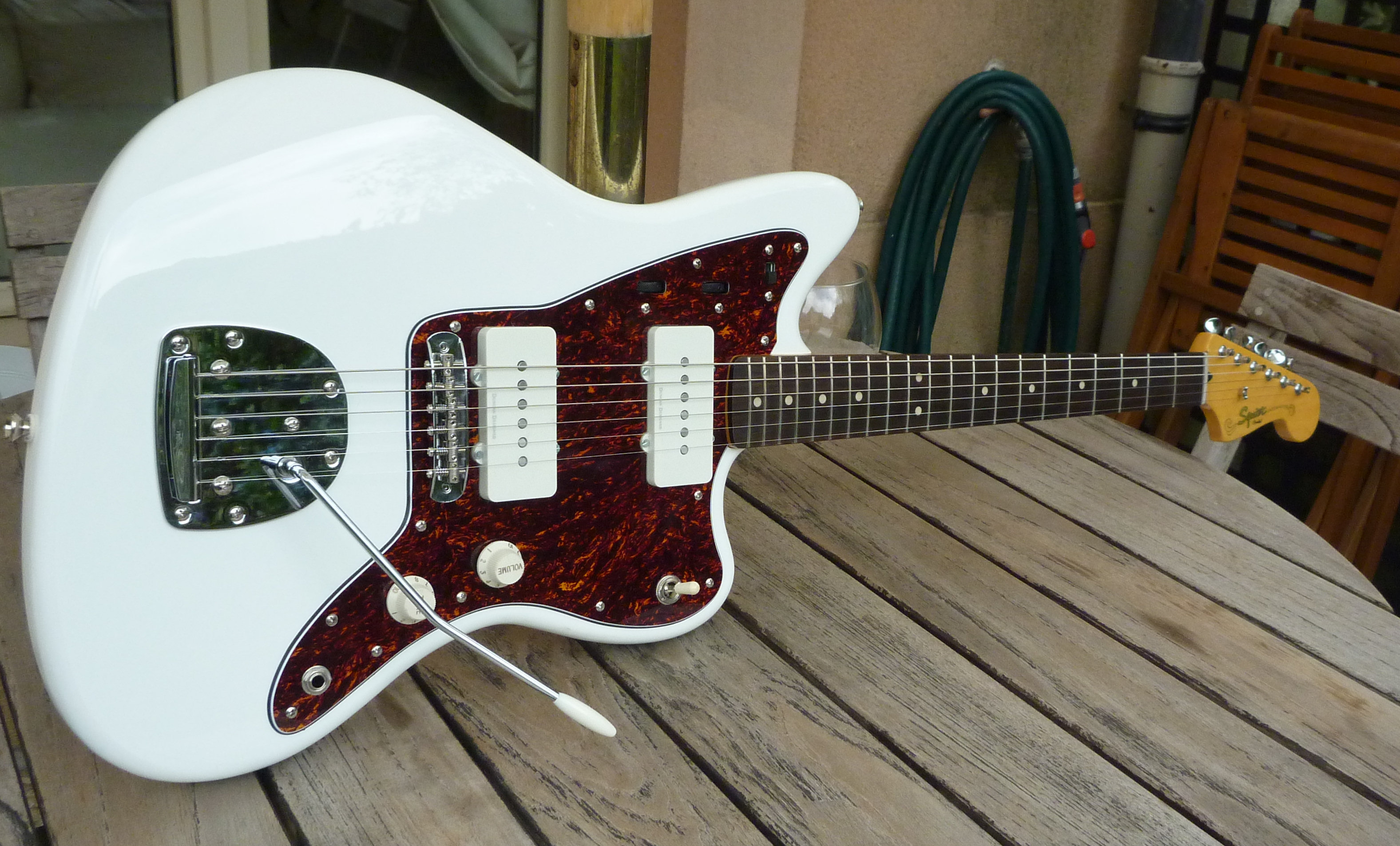
so i bought a secondhand Squier Jazzmaster. the price was so ridiculously low (as it is when you buy new, so go figure), i couldn't help myself.
the picture above is off the net, btw, but mine is exactly like it. gotta love them factories.
wish i had a porch to hose down or put a table on, though. anyway.

after a while i ran into the same thing that has been boggling minds of Jazzmaster owners everywhere: what ON EARTH were the people at fender thinking when they put in that top circuit? you know, the slide switch and two roller controls?

first thing i did was bypass the whole thing - no matter what position the switch was in, the sound would be the same. determined by the standard toggle pickup selector, that is.

but having two unused roller pots got me thinking:
- cheap guitar.
- owner willing to drill extra holes in cheap guitar.
- lots of fun circuits around with two pots for controls.
- Jazzmaster + Fuzz = Garage Goodness.

so off it went.
i tried breadboarding the classics (Fuzzrite, FZ-1/1a), but either i didn't really like them (fuzzrite) or they seemed too fickle (most notably the Ge FZ-1. would've been nice to run it off AA batteries, though.)
so in the end i threw in a derivative of an Elka Dizzy Tone i traced some years back, that i had adapted for negative ground (not that that matters, since i'm onna run if off a batthree) and that i skipped the tone control on.
this is the schematic:


i did use silicon for the darlington to improve reliability.
and i drilled some holes..


yup. that's room for a battery clamp right beside the pickup selector, wires running through pickup routing, to go to the funky pink perfboard. because i could.
and i could've had all that underneath the pickguard with the back of the guitar intact, but if you've ever taken the pickguard off a jazzmaster i'm guessing you know how much i was looking forward to changing batteries. enough to drill a hole right through, indeed.
oh, and to save battery life, i replaced the jack with a stereo one so the battery only connects when the guitar is plugged in.

personally, i think it sounds amazing, and i like the flick-of-a-switch type action. lots of different tonalities through combinations of the two fuzz controls and the guitar volume/tone as well.
and it sputters and oscillates like crazy when the battery starts to die, which can be nice, but it's not for everyone. or for me on a daily basis.

must go out and buy fresh batteries.
have to do a video, maybe.
Gnarl's up!

28.2.15

Principium 2.0: live preview


it's not quite the finished set of 12 yet, but as you can see we did get 4 copies ready.

did a small preview/concert with at De Player for ART Rotterdam.
already lots of fun - can't wait to try this with TWELVE of these things!

as mentioned before, each record contains a single droney note, varying in octave/timbre in time.
i played around with the pitch of the record players to try and make different chords. quite the challenge.

(pic is a still from a shakey movie by DePlayer's #1 busy bee, Koos.)


4.2.15

Principium 2.0

in the process of putting together Principium 2.0 - the Turntable Edition!


based on the work of Vaast Colson, Principium 1.0 was a hacked one-octave Casio keyboard, to be played by placing magnets on a coloured playing field.
on friday we're presenting the second version at The Player, Rotterdam. stoked!

the kind people of De Player asked me if i wanted to do a record of the Principium 1.0.
needless to say, it turned into a different beast. based on the same grid of colours, we ended up with a single set of 12 records - one for each note of an octave.

the sound of these records is, like in the first Casio version, to be turned on and off by magnets again. only this time the rotation of the turntable provides the sequencing - magnets are to be placed around each 10" record, their presence picked up by a sensor, activating or blocking the sound.

speaking of which, the sound on the first record is a 10 minute composition centered around a C note, varying in timbre and octave, recorded on organ an the trusty MS-20.
this recording then got pitched up a semitone for each subsequent record, making each next record just that little bit shorter.


see you on friday.. and if not, i hope to 'play' the full set in antwerp sometime soon!

3.2.15

Jam Jar Comes Alive


the prototyping is over.. and it's alive, alive i tell ye!

recycled a set of discarded organ foot pedals, hooked it up to a pretty nifty (if i do say so myself) yet extremely rudimentary (if i do say so myself) square wave synth, and ran it into a horn driver i had lying around.

the original plan with the horn driver was to make a talkbox.
it became a wooden box instead. also fine.

the whole thing is monophonic, but the nifty part is i came up with a way to play power chords by pressing a single note on the pedals - you can mix the base note, a fifth up and an octave up using the three knobs on the left.
master volume on the right.
in between is a switch to throw the whole thing another octave up.

i'm quite happy with it, i must say, although it's pretty hard to play.
in a way it's so ridiculous it becomes poetic. well, almost.

video footage here!


26.8.14

prototyping

making a mess.
more soon, hopefully.


6.8.14

EHX Small Stone Modding

just a quick writeup on my latest venture into modsville: the Small Stone.

on the wish-or-want-to-try-list:
- get the effect to be more subtle at the twist of a knob (aka mix),
- a depth control might be nice (as in: amplitude of phase sweep)
- fix volume drop when pedal is engaged.

i found some of the stuff i needed on the net, came across some stuff i didn't think i'd need but sounded interesting, and couldn't find info on the depth control.

so, here we go.
#1, the classic: univibing. swapping capacitors in the phasing stages to get the sound closer to a univibe. liked the effect, didn't care for the option of swapping each stage individually too much, so i ended up throwing in a 4PDT, moosapotamus-style.

#2, the mix.
i tried what a lot of people refer to as a 'depth' mod, which alters the ratio of the mixing resistors and throws in a pot for the occasion. it does go from clean to vibrato (don't really like it as a vibrato, but ok). problem with this is that as soon as you flip the Color switch, you send phased signal back to the input to create extra resonance - and while that's nice, it also means your clean signal is now no longer clean, rendering this approach to the depth/mix mod sort of useless. to me, that is.

i tried running the feedback path to the second phase stage (like the Ross Phaser), seeing how that would solve that issue, but i didn't like the sound as much. it's still a valid idea, i guess, if you're into that kind of sound.

now, i already modded another small stone with a buffer in front and a booster at the end to compensate for tone suck/volume drop, and i was going to redo that with this one.
so i figured i could lose the mixing stage of the original effect altogether, take the buffered signal as the clean end for a new mix control, and still have the extra resonance the color switch provides.
works beautifully, as it turns out. you do get a slight volume boost at both extremes (the phasing effect is in the middle of the rotation, and it's always going to cost you some volume - nature of the beast) but i don't really mind. not enough to want to fix it, anyway.

#3, speaking of that color switch:
i altered the resonance/feedback path slightly. took out that half of the color switch and basically replaced it with a pot. 500K sounds exactly the same as no feedback at all, 10K minimum stops it from squealing - and you get everything in between.

the second half of the color switch messes with the LFO, and alters both the depth (the LFO's amplitude) and the speed of the effect.
i swapped it out with a SPDT because it was easier to position than the original bulky russian 2PDT.
i put in an on/off/on switch because it was what i had lying around, but the difference between the off position and the regular mode is so subtle i wouldn't bother with it too much.
since i was still hoping to find a solution for the depth control, i thought about fixing it in the deepest (color 'on') mode and bringing it down afterwards, but it turns out it still sounds a little different. maybe it messes with the waveform (haven't scoped it), or it shifts the whole waveform up slightly, i don't know. anyway, decided to keep it, in spite of coming up with

#4, a way to control the LFO's amplitude.
i read up on OTA's a bit, and i learned they spit out current rather than voltage. what's more, they do so based on the difference in voltage between their two inputs, much like regular opamps. so i figured if i wanted to control the amount of current coming out, i might as well try to control that difference.
and yes, if you hook pin #2 to pin #3, rendering the difference 0, the lfo shuts down.
i went the crude way and hooked up a 100K pot between both inputs. at 100K, behaviour is the same as before. turning the resistance down, the amplitude drops and the phasing gets more shallow.
there is a certain point where the speed is affected as well, and the whole thing speeds up quite dramatically. i don't mind. it can probably be avoided by someone who knows what they're doing.

#5 fixing the volume drop:
as i said, i surrounded the small stone with a 4558 buffer/booster combo. standard stuff, really.
it seems it needs quite a bit more boost than before, probably because i skipped the input 2xtransistor stage of the effect and used the plain buffered guitar signal for the clean end of my mix.

#6 bright mod:
straight from the moosapotamus' mouth, i put in the 0.1uF instead of the 10uF.
didn't bother with a switch. i like my treble spanky, and i loved it as soon as i heard it.
really retains your original sound.


here's the schematic for my ramblings:


give it a go if you'd like.
let me know if it works for you.
oh, commercial modders: some cold hard credit would be nice if you feel like offering that depth thing.. wink wink, nudge nudge.