16.5.20

Vox Foundation restauration

i'll be honest - i was looking at the Jext Telez 'White Pedal', being utterly fascinated with some 60's bands' Fuzz Tone. and then i came across this here second hand beauty: a Vox Foundation Amp.


marketed as a bass amp, this series of amps (the Supremes) was basically Vox cutting and pasting with different preamp modules and different power amps.
so this is a bass amp, because it lacks the tremolo and reverb as found on the guitar versions (the more notorious Defiants and Conquerors.)


>> here's a Defiant in front of a Vox Conqueror. ha. ha.
(did i tell you about how i met Yoko Ono at the vennice biennale in 2003? maybe some other time. she was nice, though.)

anyway, back to the amp - apart from these omissions, the preamps and the power amps are exactly the same. the distinction becomes pretty small, especially with there being a 'normal' and a 'bass' channel on the Foundation.. very Fender Bassman-ish, i guess.
and what do we see on the normal channel?
yes indeed - distortion, and the infamous MRB or mid-range boost. like a fixed wah. so, think that same White Pedal, but unwieldier. is that a word? yes, it is.

now this was for sale as is, meaning: it hums like a bastard and that's all she does. but since i could get my hands on it for less than the price of the above mentioned pedal, i decided i could always try to get the preamp (my section of interest) up and running and gut it for a True Vintage Kvlt Pedal or something.
i gave that a half-assed try at the time, noticed even the mixer section (mixing both channels together to feed the power amp) was giving me overdrive - not good - and put it aside as there were far more urgent matters to attend to.
and then, of course, it sat there on the shelf for two years plus.

last month, however, the global pandemic that is Covid19 allowed me the opportunity to lock myself in and get kicking on some projects that i had been neglecting for too long.

with some help from Nick over at www.voxsupreme.org.uk, i dated it based on capacitor codes etc.. this particular amp was placed rather firmly in february 1967. that makes it over 50 years old, and one of the earliest ones to survive at that. all of a sudden, the idea of tearing up an amp with that much history, and an amp type that's becoming increasingly rare at that, just for the preamp/fuzz.. i just couldn't do it. call me sentimental.

so i set out recapping this bad mofo.
out the window with vintage value, i say - the show must go on!

'normal' aka guitar preamp board
upon closer inspection, it turned out that every single electrolytic cap needed replacement. and not just in the power amp: every single one of them. you see those little yellow buggers? dry as a hungover crust punk's throat on a tuesday morning. no wonder the whole thing was out of whack.
that same board after recap, for reference..


nice and shiny.
did every single board, replaced just about every cap in there, for both pre- and poweramps.

Full pre: 'normal', mixer, 'bass' boards. MRB caps + coils to the left.
in the pic above, notice the hammond-organ style connector bottom right: that connects preamp and power amp sections, feeding power to the preamp and returning the preamp's signal to the power amp. meaning power lines and signal are running through the same unshielded multicore cable. there's better ideas out there, i guess.

it still hums quite a bit, but in light of the signal to noise ratio, not a problem. because make no mistake: at 50 watts, this thing will blow the windows out of your neighbours apartment. it is not just loud. it is LOUD. like it's-the-sixties-and-what's-a-P.A.?-loud.

the sounds are more than decent for guitar, at least on the normal channel (the X-tone on the bass channel doesn't play nice with 6-strings). it does have that immediate directness i associate with high power transistor amps (jazz chorus, anyone?), which can be the greatest thing ever or the most annoying thing ever, depending on who you ask. honestly, i never could get along with those kind of amps - but i'm as yet undecided about this one, because unlike the jazz chorus it breaks up nicely and the fuzz is totally lovely. even if it is not as loud as the clean mode, and even if it pops like a basterd when switched on. the MRB might be more of a gimmicky feature than i had hoped, but i guess for studio use it can definitely have its moments. maybe i'll think higher of it after using it in a band situation. so i guess i'll have to play it some more to get used to it, because i'm really used to the sag and compression of my trusty AC15.. but it makes for an interesting addition to the family, to say the least.

11.5.20

Principium 3.0: under the hood 3

aah. wiring.
the keyboard obviously has thirteen wires: one common (+3.3v) and then one for each key contact, all running to Bela's digital I/O pins.
add in twelve pulldown resistors to make it all behave: done.


next , i threw in the only thing i bought extra. an M-Audio Midisport 1x1. cheap, reliable, small footprint when uncased: no need to reinvent the wheel there. in the end i ran wires from the input port to a panel mounted 5 pin jack, keeping the integrity of the M-Audio. because you never know.
i cut a USB cable in half, plugged it into the Midisport, and soldered the other end to the bottom of the BBB's usb host port. a plug would have been in the way too much there. so now Bela recognises it at startup and acts as a host - works flawlessly. if i ever want to use the host port for something else, i can just unplug the Midisport.

then - a little show and tell for jack wiring.


i used switching jacks, and came up with the above.
a single mono cable in the left output jack sees a mono mix of the L and R channels through the two 1k resistors.
obviously we can put another mono cable in the right output jack - that breaks the mixdown connection and now we have dual mono, split stereo, whatever you want to call it: L channel on L jack, R channel on R jack. the standard, quoi.
what you don't see too often is option 3: nothing in the left jack, but stereo on a TRS cable in the right jack. nice for using a Y-cable. and if you should accidentally plug a mono cable in there with the L jack empty, you'd just pull the L channel to ground through the 1k resistor, so no problem. no stereo, no mixdown, but no problem.


 then, horror of horrors - the display.
i picked a double digit 7 segment display out of the scrap box. must've pulled it out of something, but can't remember what. tested it, got every segment lighting up on the breadboard - great.
ordered me some 40110 CMOS counters, since you can clock those to count up and down - perfect for bank selection - and they can act as a 7 segment driver! sounded Purrfect.
however.
in my enthousiasm, i failed to realise there's two types of 7 segment displays: there's common cathode, which the 40110 likes very much, and then there's common anode, which the 40110 doesn't quite get along with. guess which one i had.
now i could have ordered me some new IC's, but that meant waiting.
i could have inverted all the 40110's outputs, but that meant inverting 14 signals and it seemed like too much hassle - and real estate.
i could have ordered me a new display, but it had cost me so much effort to make a hole in the front panel to fit this one, that i didn't want to go through that again. (and believe me, i checked - couldn't find any new ones with the exact same dimensions.)


in the end, i dug up an ancient Arduino Duemilanove which wasn't seeing much action - C++ and all, you know.. not my bag - and i guess it's about to go unsupported soon anyway. hah.
the benefits were that it could receive 3.3v signals and see them as HIGH (which the 40110 wouldn't have running at +5v), i could invert however much i damn well pleased, there were 7 segment libraries to be found and, within reason, i could interface with the display directly without having to come up with extra circuitry.
i tried to multiplex the two digits with the SevSeg library. meaning: the arduino lights up one digit at a time, but so fast you see both of them light up. which spares you some pins, since you only need 7 segment pins and not 14 for two digits. now, this only worked with resistors on the segments for me (the other option being resistors on the digit pins), and results in terms of luminosity were disappointing to say the least.
after much trial and error and measurements, i actually initiated two SevSeg objects (one for each digit), i'm driving every single led LOW on it's own pin on the Arduino, and i'm using every single pin on the Duemilanove except one (0= rx).
the display power source is the raw +5v output on Bela (straight from the wall wart, basically), the Arduino itself is powered from the regulated +5v USB out on Bela to the +5v pin on the Arduino. i know this is not recommended practice, but that's only because you then bypass the arduino's own regulator. since this is already regulated it won't damage anything.

i don't know the specifics of the display itself, but the current limiting resistors i used were surprisingly low: i have 100 ohms on each pin, and current draw is about 170mA when displaying the number 88 (all segments lit.) that's not too close to the 200mA limit of the Arduino, and i don't see myself using 88 soundbanks any time soon. every other number is below that: on average i would say i'm drawing something like 100 to 120mA, which seems fine.
the only thing that is a tiny bit stupid is that, at startup, the segment connected to pin#13 lights up by itself. probably to do with the internal resistor+led. if i feel very brave, brave enough to brave the hot glue barrier i created myself, i might swap that pin for the DP on the display - the decimal point, aka the little dot in the corner. wouldn't mind that so much.


close-up of the opened back panel. to the left is Bela, usb cable for the midisport visible underneath. the microSD card is right next to the miniHDMI, so easy enough to pull. next to Bela is display driver buddy Duemilanove. which has a little reminder to unplug the +5v line should i ever want to reprogram it.

Principium 3.0: under the hood 2

now then. Finally on to hardware hacking!

years ago i found an old midi keyboard lying in the street.
a fine donor keyboard if ever there was one. needed some cleaning up, but hey. don't we all.


.. and then all of a sudden i had a setup that seemed like it just might work.

continuing the repurposing game, i used scrap wood bits, and sliders and buttons i still had lying around. i messed up the holes for the buttons and display pretty badly, and i hate the shiny white kitchen cupboard material to work with with a vengeance. well, once you start, no way back.


all oiled up!
now just cram everything in there.


Principium 3.0: under the hood 1

follow up on previous preview post..

i'd been chewing on this idea for a long time - i even had a software mockup of this very thing at the 2.1 record presentation, so we're talking at least july 2016. i was running the loops in Ableton, and i wrote a PureData patch that took my midi keyboard input and turned it into volume controls for the Ableton channels over midi.


(i knew i had a pic of that setup somewhere.)

but i always knew i wanted this as a standalone instrument.
now, to bring this to life had its problems - i didn't want to compromise on audio quality, and running a dozen 5-to-10-minute loops is not exactly easy with tapes or anything in the analog domain - let alone portable.
so enter digital.
i tried several platforms - i tried an Axoloti, and i tried a Robertsonics WavTrigger, both of which are awesome in terms of audio quality and ease of use. but alas, while the Axoloti shines at DSP and synths (no, really! check it out.), running 12 stereoloops continuously just isn't its forte. i'm sure i'll find a new use for it soon enough - it was just the right platform for the wrong job, or something like that.
and while the WavTrigger will handle that same wrong job no questions asked, fade in and out times (over midi) are restricted to a 2 second maximum - not nearly slow enough for my purposes (i'm running fade times of over 5 seconds at the moment) and at the other end of the spectrum i had some nasty glitches going below a couple hundred ms attack time, which is no fun for a keyboard instrument. in fairness, it only craps out on the fades - if you tell it to jump to a certain volume it will do so instantly.
i did try ditching the midi altogether and running serial control with an Arduino, calculating my own fades and whatnot. and while i learned a lot, my coding skills are still way below par, the fastest times were still glitching in the end and it all became well frustrating.
again, i'll definitely be using the WavTrigger for other things in the future - the things it does well, it does really really well. but what i wanted from it was a bit beyond its limits, i'm afraid.
i was looking at the Robertsonics Tsunami, because it has multiple outputs that i could route to, but then i'd need two of them and come up with 24 external VCA's or something..

and then someone pointed me towards Bela.
an audio-centered open source platform that runs PureData patches! a light at the end of the tunnel!


well.. in all honesty, it was a dim light and a very long tunnel at first.

i don't know the first thing about linux (Bela sits on a BeagleBone Black, basically a mini linux computer), i had never ssh'd into anything before, and Terminal was an application i had so far only opened by accident. but okay. bite the bullet.
after a bit of a bumpy ride - and a lot of forum support - i got Pd up and running with the externals and libraries i needed installed, and Bela willing to read .wavfiles from an external SDcard which will mount when hot swapped. phew!
after that, it was 'just' Pd. took me a long time, but all in all it was still relatively easy - as i will obviously take Pd over C++ any day of the week. maybe i was just happy to be on more familiar ground again.

sidenote: i never got round to trying a Raspberry Pi, because Bela caught my eye sooner.
the Pi will run Pd patches as well, and seems to be the cheaper board, so it could be a contender.
the focus is definitely not on audio though - as i understand it, you would at least need to add a decent DAC. one pretty interesting piHat i spotted was the Blokas Pisound, but then you end up in the exact price range where Bela sits. and apparently the pisound has a bit higher latency, so no regrets.
the only thing i would really like is for the BBB to boot a bit faster, but ok. their claimed 10 seconds is fast, but not while you're onstage having to reboot because some idiot pulled your plug.

10.5.20

Principium 3.0: quick preview

may i proudly present, the third installment of what is slowly becoming the ongoing Principium series: Principium 3.0!


what is it, i hear you ask? well, it's an instrument somewhere between a stubborn Mellotron and the Principium 2.0 record installation.
that is to say: it plays back 12 loops continuously, and when you press a key the volume of the respective loop opens up. so unlike the Mellotron, there's no retriggering - you get to hear the loop where it happens to be at that point in time.
to the left are master volume, and the attack and release sliders determining fade in and out times. which is actually more Solina than Mellotron, but who's keeping score.

my basic idea for a single loop is pretty simple: to have several octaves of a single note (say C1, C2, C3, C4 etc) fade in and out and overlap with eachother, disappear and reappear, maybe with different timbres, filtering and processing.
then you have twelve of those loops, each with its own dedicated note. and if they are of different lengths, they will start to overlap in unpredictable ways after a while. so if you play a sustained chord, not only will the sound 'move', but it will also be impossible to predict which inversion of the chords you'll be playing, aka which of the notes will be the highest or lowest in the chord. since with several octaves fading in and out, that doesn't necessarily respond to the order of the keyboard anymore. which is exactly what happened in the 2.0 installation.

so right now i obviously have it running all twelve Principium 2.0 records - but it reads sets of 12 .wav files from a microSD card, so it can hold multiple soundsets. hence the 'bank' selection buttons. the display shows the number of the current set. and i'm very much in the process of recording new sounds for this baby.


back panel view: above the DC barrel jack there's a stop/reload switch for safe removal of the SDcard, so you can load new files without having to reboot or power down. next to that 2 output jacks: left/mono (summed) and right/TRS, so you can have stereo over a single Y-cable. and you can even hook up a set of speakers for standalone operation!
woops, forgot the 5 pin midi input. so it accepts midi (well, note on/offs) - although an 88 keyboard will still be reduced to a single octave. and with a push of the button you can select what midi channel it responds to (from 1 to 12, selected via keyboard).

the panel on the right opens up to access the SDcard, the Bela that runs the whole thing, and the arduino that handles display duties.

still some software upgrades to do, and i need to get me some swanky fader caps for the sliders, but for now: happy camper!!


30.4.20

Pasco 9301A mod

'Fruit flies when you're having Fun', i recently read somewhere.

a long long amount of fruit ago, Wietermans Dockxmans presented me with a Pasco Scientific 9301A dual function generator. which has banana jacks. banana, get it?


anyway. the thing has inputs to modulate the frequency of the generators, but they work backwards. so higher CV input = lower frequency. which feels quite unnatural if you're driving it with other gear.
some previous owner added CV in jacks (wired straight to the frequency pots), but they had the same problem. i guess it's just how that Intersil 8038 IC works.

original schematic:


the internal modulation (i.e. modulating one generator with the other) can just stay as is.
and, of course, those huge dials need to function in the same direction as ever.
so i ended up with the following:
- run the original CV (from the dial) through an inverter, so that it's flipped the wrong way round.
- add the external CV and any needed offset to it.
- run all this through a second inverter, so that the original is back where it needs to be, and the external CV is flipped (which was the original objective.)

crudely drawn schematic:


for clarity's sake: i pried loose the connection between the freq pots and the pcb. this sits in between there now. i do realise it is rather crude, in that the original frequency scale of the dials is no longer valid. i had to scale the whole thing - both CV and original pot voltage - down to a useable range.
i probably could have more or less avoided that, but i'm not sure i could get it done with just a single 072. and anyway, since the amount of possible pitch shift is dependent on the chosen setting of the oscillator (one of 5 ranges), and it never even comes close to V/oct, this is basically a fancy Spacey noisemaker so i quit caring about accuracy. mainly i opted not to introduce unwanted distortion at the extremes of CV input.

in the end i added a master volume as well (bottom right in top picture.)
looking at the schematic, there's probably a lot more options for mods, external VCA  inputs etc., but it's pretty versatile as is so i'm not sure if it is worth the extra trouble.

 both channels' CV mix boards.

CV input jacks and master output jack.

4.12.18

Dual Reamper build


got asked to build a reamper - well, not one, but two.
the idea is that in a studio environment, it can be a lot of fun to run just about anything from your DAW through a pedal+amp setup again.
even more fun is the possibility to run everything in a nice wide stereo.

so, what we decided on:build two mono reampers in a single box, for convenience.
more convenience is provided by Neutrik Combo Jacks.
we want the possibility to run just one input to both outputs (mono in, stereo out), to use two different amps on one guitar at the same time, for example. or to layer two effect chains - you name it.
that does require the extra possibility to flip the phase, if you want it done right.

i thought about having 'master' functionality where one set of controls would control both paths at the same time, but since the whole idea of this setup is mostly to be able to use two different chains, they will probably require their own settings anyway. so that idea got scrapped.

a little google session gave me a couple of interesting links.
i used the same Edcor brand xformers as they do here, which basically uses a variation on the classic Jensen schematic. no need to reinvent the wheel there.


while Jensen proposes a 10K:10K, some schematics use a different ratio xformer, like 10k:600. terminating the secondary with a resistor closest in value (680R). i tried both varieties, and i must say the 10K:600 doesn't quite cut it for me, levelwise. it just doesn't provide the punch of the original signal to my ears.
the 10K:10K, on the other hand, provides ample level and will play very well with dynamic recording levels in your DAW.. read: if you're not pushing up against 0dB all the time it's about plug-and-play without too much fiddling with the level control. so that'll be the transformer of choice here.

as for phase switching, i found several people hinting at just swapping the wires of the (isolated) output jack. while that might do the trick in a standalone mono box, it didn't seem to play nice in the dual box i was building. so i flipped phase right at the secondary, before going into the level pot. that works well.

one thing i was sort of worried about, was feeding two transformers with a single signal, without a buffer of sorts. worried about impedance issues and whatnot.
testing with my own soundcard, there was no problem at all - no audible difference on the outputs while feeding one or two chains. no problem, no problem solved. hah.

here's the full schematic of the build.
who knows, someone might have a use for it.
someday.


7.3.18

huh? ...how long was i out for?

it's been over a year since the last post.
well, my last post here, not The Last Post.
managed to avoid that, thankfully.

and what a year it's been.
but i won't bore you with the details.

relevant stuff for this space:
played some shows, quit some bands, started some new ones.
made some records. and an exhibition.
cobbled a new-ish guitar together.
built a 40-slider autofading tremolo shizzamathing for Floris Vanhoof.
built a laughing organ for Michele Matyn.
more on those later.

will try to keep the updates coming more regularly.
and for now: a late happy new year.

Jagmaster. Jazzuar. Partscaster.

came across a pair of Teisco Gold Foils in the parts bin that had been out of use for several years.
hooked up a jack, tried them - and boy, do these deserve to be in a guitar!

so, on the lookout for a body donor guitar.
i ended up buying a Fender Classic Player jazzmaster body from Stijn Kenens, all-round good guy who also happens to be the luthier down the hall.
the Classic Player is the model where they moved the trem closer to the bridge to increase the break angle. so not truly 'vintage correct' - but whatever. this was never going to be vintage correct anyway, and it was on the cheap.
stripped it of its black finish, and out came a rather nice alder body (according to Stijn.)
i thought it looked just a little too light in colour, and as i was looking for a way to avoid heavy chemicals, i ended up staining it with walnut bistre. which turned out great - except you need to dilute it with water, so any oil or waterbased laquer i would put on there would instantly ruin my staining job. even after it dried. so far for the nontoxic plan - and i reached for the clear laquer spraycan.
which worked out just fine.

since i have this Squier VM jazzmaster with a built-in fuzz in lieu of the rhythm circuit, and since i'm sort of addicted to that, i was thinking of doing another effects-laden axe.
thing is, jazzmaster pickguards are a bitch to take off and put on - so jaguar style control plates seemed a nifty solution. making the wiring job easier, easier battery switching etc.
only problem there: i couldn't just put on a jaguar pickguard, because the body size, scale and therefore bridge position differs from the jazzmaster. and i couldn't for the life of me seem to find jazzmaster pickguards without pickup routing.. and the gold foils are considerably smaller than JM soapbars.
so i ended up routing a pickguard myself, based on a JM routing template i borrowed from stijn, cut short at both ends to make room for the chrome jag plates.
i slightly fucked up the routing for the pickup selector plate, but it's not too bad for a first attempt :) and no one will ever notice from a distance. and, oh yeah, whatever, anyway.

i bought myself a second hand squier jazzmaster Affinity neck.
seems to play ok, will see if it will hold for the long run.

tried several wiring options - phase switch, series, parallel, whathaveyou.
in the end i went with series wiring and a phase switch for the mid position.
the actual tonal difference between parallel and series was negligable, but series was way louder. and therefore better suited for the out of phase sound, where you will lose some volume anyway.
and hey, if this kinda wiring works for Brian May..

tried several values for the volume and tone controls, tried treble bleed circuits, extra resistors like in the original jag wiring, yadiyadiya. ended up with just a 500KB volume, ran the full hot signal into a 10K resistor + 500KA tone pot with a .01uF to ground. the 10K keeps everything from going into full closed-tone-pot-shutdown, a sound that's too dark and unusable to my taste.

now i just need a black tremolo tip, and i need to decide what to put in the rhythm circuit.
fuzz is always good, methinks - but trem can work with two controls just as well.. hmm.

pic below: still working on the tone control values at the time, by now it's got two knobs and that black trem tip. she's a beauty.


20.10.16

Pieces on show

this saturday, the good people of Kraak invited me to take part in this one-off:
http://extracitykunsthal.org/ECK13/en/guestprojects/kraak-presents-traitor-you-left-fluxus/
which promises to be a very interesting evening..
i'll have the Principium Casio and the 2 octave jam jars on display for everybody to fiddle with.
come on over!

10.8.16

interview

Joeri Bruyninckx interviewed me about the Principium 2.1 record..
read it HERE!

Boomkat described the record as "conceptual sound art that recalls Oval wrecking Wendy Carlos' Clockwork Orange score".

i chuckled. :)

30.7.16

Damn

rest in peace, Ray Wilson.

27.7.16

Jam Jar's bigger multiheaded brother


made a follow-up on the Jam Jar for an exhibition based around one man's huge hifi collection.
decided to mix my own collection of "useful things to one day use" with his. i used 24 jam jars i found in his garage (used to store nuts and bolts), put in 24 mini speakers, driven by 24 new amplifiers (simple 386 circuit for you electronerds out there).
dug up a pcb containing a full octave set of oscillators i had lying around - used to be the heart of a very disposable crappy italian organ - and added 12 dividers: et voila, 2 octaves of square wave goodness. tweaked the oscillators' caps to end up with a 60/40 PW wave for improved harmonics, so the 'wah' sound jumps out a bit more when you twist the lids.
the wooden base i made from the man's old shelves. recycling ftw!


exhibition was quite funny, nice to watch the audience go wild on this thing.
video or sound coming soon, hopefully.

Principium 2.1 in full effect!

i still can't quite believe it, but it happened - the bits i chopped out of the 8-hour performance that was the presentation of Principium 2.0 got etched onto vinyl!
may i proudly present, my first full length release on the wonderful Ultra Eczema label: Principium 2.1..


no reason not to get them while they're hot. 300 copies y'all!

we had a lovely presentation at Stadslimiet, showing the history and possible future of the Principium series. there was an original by Vaast Colson, the Casio 1.0 version, my own copy of the 2.0 vinyl+electronics, and a preview of a vague dreamy idea to turn all 12 records back into a mellotron-sample-playback instrument. right now it's running on Pd/Ableton, but i'm hoping to ditch the laptop altogether some day for a 2.2 version, or something.


23.2.16

Principium 2.0 in full effect


on july 2nd, we had a presentation of the full stack of 12 records that make up Principium 2.0.

i'm only posting this now, because the whole performance lasted for eight hours, and i only just finished going through the full length recording to chop out some interesting bits.. quite the chew.


the setup was the following:

- 12x 10" records, each containing a single note drone. the full set equals notes from C to B.
like the rows of the original artwork matrix, they were in 6 pairs of the same color.
- 6x record players, each dedicated to one vinyl colour.
- 6x custom electronics, basically a crude gate based on a magnetic sensor. gates work in 2 modes, either standard gate behaviour (sound when magnet is sensed), or punching silence when a magnet is present. these modes are independent for L and R channels.
- 8x magnets per record player, taking the role of the columns of the original.
underneath the 10" vinyl is a 12" metal base, leaving 1" around the vinyl to place magnets on.


i decided to build myself a random score generator/ conductor in Pd.
basically, with every press of the button, it decided for me in what order and combination the vinyls would have to be played. for every vinyl that reached its end, there would be a random decision to either play that record again, play the other one of the same colour, or leave the turntable empty, introducing silence. that decision would also be applied to the other turntables that were empty at that moment.
the program also gave me the number of magnets that needed to be on every turntable, the mode switch settings and the turntable volumes.


(click pic for closer look at pd program screen, and possibly the loverly youngsters of Mittland Och Leo watching the installation.)

seeing how the vinyls all have different lengths, the overlaps are quite intriguing..
started at three in the afternoon, and ended at eleven at night sharp. with a wonderful instruction from the program to leave all the turntables empty. first time it had done that! that was an insane moment. i love it when technology pretends it's cognitive.

thanks to Alex Dumitran for grabbing this screenshot:


excerpts to be uploaded soon!
all twelve Principium 2.0 boxes that were used in the installation have been sold, so those of you that are interested will have to wait for a possible release of the recorded material.
i guess that would be Principium 2.1..

8.2.16

Welson S12: boom boom tschak

today i proudly present Frankenstein's Daughter: the Welson S12 Remørk edition!


so what have we got:

- trigger buttons for all sounds.
kick, snare, (snare roll, claves, tom1, tom2 as per the original), hihat, and open hihat. that last one does require a hihat trigger as well, since it just modifies the decay of the same sound source, so it's a bit fiddly - but it's very workable, really.

- individual volumes for all sounds.

- snare drum roll speed and routing.
instead of always co-triggering tom1, you can now select which (if any) of the other sounds get triggered alongside the snare noise. combos are very well possible.
all sounds but the hihat - that'd be ludicrous, seeing how it's just the same noise as the snare top end.

- open hihat volume.

- pitch and length control for clav, t1, t2, kick.
the dual gang pitch pots worked to a certain extent. you can still feel the circuitry is a lot more prone to oscillation in certain ranges (depending on the third, fixed resistor in the twin T network, no doubt), so it is very interactive with length and volume controls - by necessity. meaning, basically: mind your speakers when roughing the pitch and length knobs. but hey, it's modding, not design.
you just have to be a bit careful about the sounds jumping into a wild screech. which can sound lovely, by the way.
length takes you from an atonal click, through poor man's 808 boom, to full on oscillation. there are some sweet spots along the way, like when it's oscillating but you can still hear the trigger's impact. does a nice compressor ducking thing.

- individual outputs.
that row of jacks in the back is wired 808-style: every sound you plug into - to add effects or whatever - gets taken out of the master output's mix. works like a charm. no need to change the classics.


it might not be as full option as i could have gone (midi triggers, anyone? that data crossbend thing on a matrix?) but it's a damn great start as it is. and extending the mods is always a possibility for later.
sounds coming soon, hopefully, if i get the chance to record a bit more before it goes to its warm loving home..


1.12.15

Welson Super-Matic S12

dear fellow tinkerers and lovers of the vintage and obscure.
i got one of these in recently:


aah. cheese.
it came with the question if it was possible to have separate triggers and outputs for all the sounds, possibly individual volume controls etc. foolishly, i gave my standard answer ("sure!") before realising there was no such thing as a free interweb-floating schematic of this thing. nooo infooo whatsoooever.

so yes, i set about doing just that.. tracing the fucker.
partial schemo below. didn't do the bottom board, which is the rhythm and pattern generator. you're on your own there.

so 6 hours later, it turns out there's 4 twin T based oscillators (kick, tom1, tom2, claves) and 2 filtered noise sounds (hh and snare.)
the hh has a long and short option. the snare always triggers tom1 with it to add some bottom end, and includes an LFO in it's trigger circuitry that allows for drum rolls. note that that means the rolls have a fixed tempo, as in: not a division of the master tempo. just let it go fast enough, no one'll ever know. nifty. i would think that also means that snare triggers have to be short enough so as to allow for less than a full LFO cycle, to avoid double hits.
when tom1 is used on its own (in exactly 2 presets), it's made slightly longer - in a vain attempt to set it apart from the snare sound, i would guess. oh, and there's an accent trigger on the output amp.

good modding news: there's prefab trimmers for oscillator gains (usable as length controls), volumes and roll speed.
twin T oscillators are not the friendliest to throw in a pitch control, but i hope to manage that by using dual ganged pots replacing the series resistors in the first of the T's. hope to manage additional manual triggers for kick, snare and hh (complementing the funky Big Buttons already there.)


the real fun starts when you start crossbending what is essentially crude data lines - using the trigger line for the samba clave rhythm on the kick, for example. here's a quick and dirty example of that. i think it sounds gorgeous.

the casing and the way the whole innards slide in do not exactly leave an abundance of space to put extra switches, knobs and pots in, so we'll have to work our way around that..


1.3.15

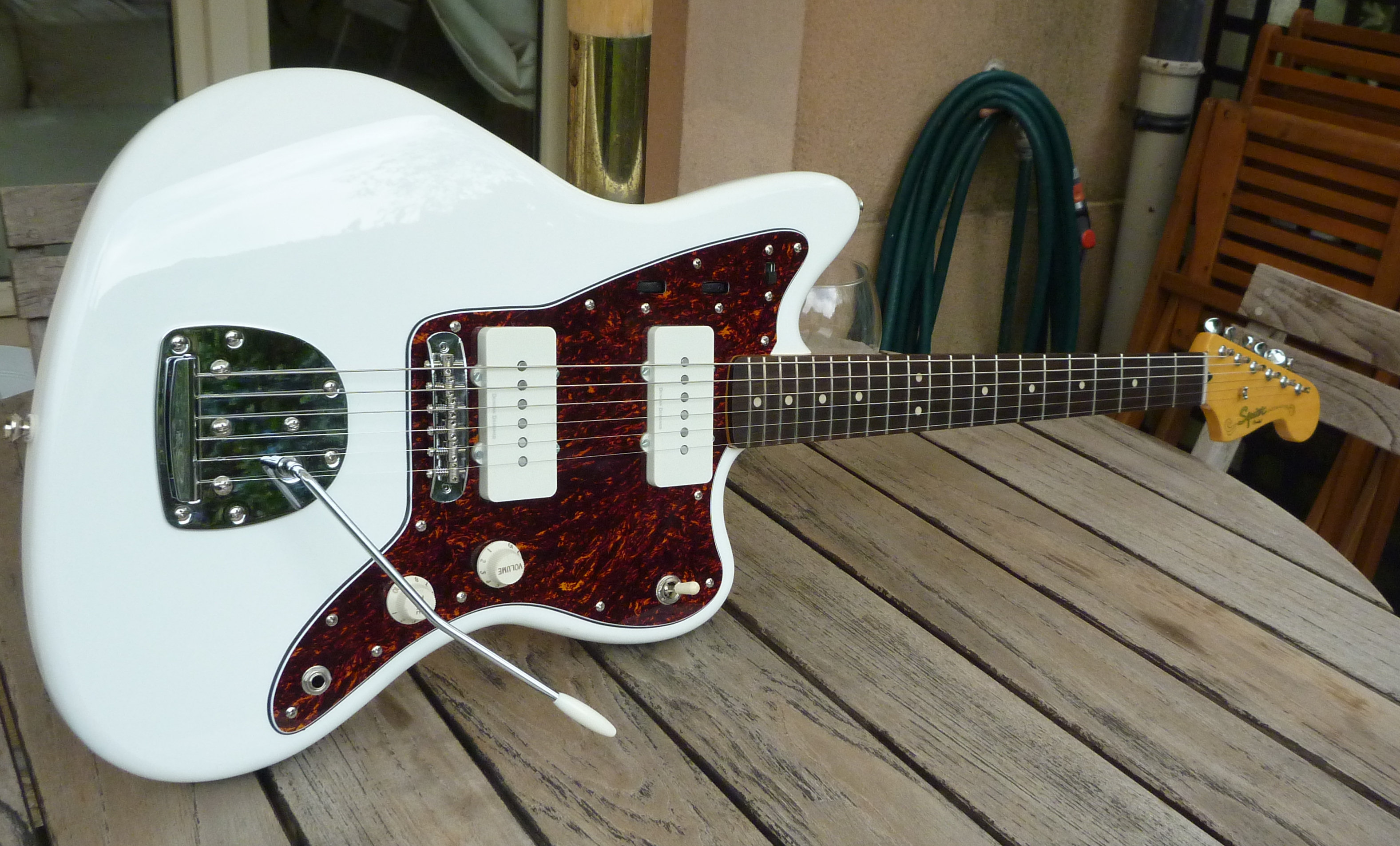
Jazzmaster - now what?


so i bought a secondhand Squier Jazzmaster. the price was so ridiculously low (as it is when you buy new, so go figure), i couldn't help myself.
the picture above is off the net, btw, but mine is exactly like it. gotta love them factories.
wish i had a porch to hose down or put a table on, though. anyway.

after a while i ran into the same thing that has been boggling minds of Jazzmaster owners everywhere: what ON EARTH were the people at fender thinking when they put in that top circuit? you know, the slide switch and two roller controls?

first thing i did was bypass the whole thing - no matter what position the switch was in, the sound would be the same. determined by the standard toggle pickup selector, that is.

but having two unused roller pots got me thinking:
- cheap guitar.
- owner willing to drill extra holes in cheap guitar.
- lots of fun circuits around with two pots for controls.
- Jazzmaster + Fuzz = Garage Goodness.

so off it went.
i tried breadboarding the classics (Fuzzrite, FZ-1/1a), but either i didn't really like them (fuzzrite) or they seemed too fickle (most notably the Ge FZ-1. would've been nice to run it off AA batteries, though.)
so in the end i threw in a derivative of an Elka Dizzy Tone i traced some years back, that i had adapted for negative ground (not that that matters, since i'm onna run if off a batthree) and that i skipped the tone control on.
this is the schematic:


i did use silicon for the darlington to improve reliability.
and i drilled some holes..


yup. that's room for a battery clamp right beside the pickup selector, wires running through pickup routing, to go to the funky pink perfboard. because i could.
and i could've had all that underneath the pickguard with the back of the guitar intact, but if you've ever taken the pickguard off a jazzmaster i'm guessing you know how much i was looking forward to changing batteries. enough to drill a hole right through, indeed.
oh, and to save battery life, i replaced the jack with a stereo one so the battery only connects when the guitar is plugged in.

personally, i think it sounds amazing, and i like the flick-of-a-switch type action. lots of different tonalities through combinations of the two fuzz controls and the guitar volume/tone as well.
and it sputters and oscillates like crazy when the battery starts to die, which can be nice, but it's not for everyone. or for me on a daily basis.

must go out and buy fresh batteries.
have to do a video, maybe.
Gnarl's up!